
Common questions about leasing commercial space
Commercial leasing should be easier to understand. Here are plain answers to the questions businesses ask most often when they look for office, retail, warehouse, or flex space to lease.
Lease Local is a marketplace for commercial space for lease, with a focus on small businesses. It does not list homes or property for sale. You can browse listings for free, and owners and agents can list space on the site.
This page is general information, not legal or tax advice. Check lease terms with an attorney or advisor before you sign.
How much does it cost to lease commercial space?
The listed rent is rarely the full monthly cost. Commercial rent is often quoted per square foot, and many leases add taxes, insurance, utilities, and common area charges on top of base rent. What is included depends on the lease structure, so ask the owner or agent which costs you will pay and how those charges can change. Compare the total monthly cost, not just the asking rate. A per square foot rate can also be unclear, because space is measured in different ways. That is why every listing on Lease Local shows rent per month, the number a business needs to plan its budget.
What is a triple net lease?
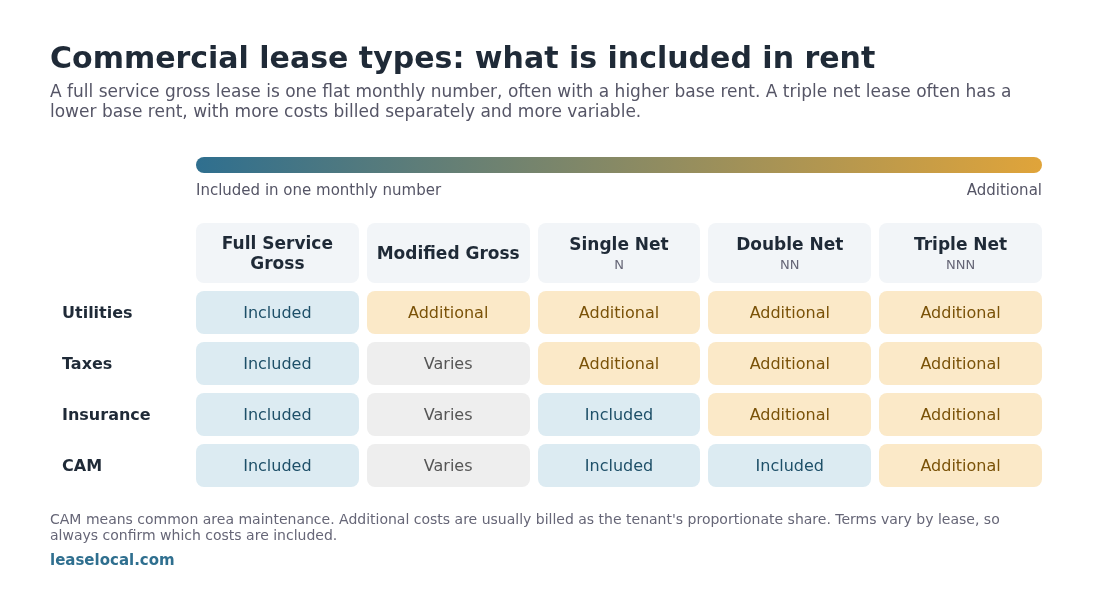
A triple net lease, often labeled NNN, means tenants pay their proportionate share of taxes, insurance, and common area maintenance on top of base rent. At the other end, a full service gross lease bundles those costs into one rent number. Modified gross, single net, and double net leases fall in between. Because the structures differ, two listings with similar asking rents can have very different monthly totals. There is no universal standard for how these terms are applied, so every Lease Local listing shows base rent per month, with each additional cost listed by item below it. That makes it easier to compare spaces side by side.
How much commercial space do I need?
The right size depends on how your business actually operates, not on a generic rule. Start with the rooms, workstations, customer areas, storage, and equipment you need, then leave room to grow during the lease. You know your business best, so tour each space in person to understand it and picture your business operating there.
How do I start looking for commercial space for my business?
Start by writing down your budget, the size you need, the areas that work for your customers and staff, and the features you cannot do without, such as parking, power, or visibility. Then browse listings and contact the owner or agent about a tour. You can search Lease Local without an account. Search by city, then filter by space type, size, and price. Create a free account when you want to save spaces or send a message. If you prefer representation, you can also browse our agent directory.
What do I need to lease commercial space for the first time?
Most owners will ask for a few basics: what your business does, how much space you need, your target move in date, and some proof you can pay, often recent financials, a business plan or a personal guarantee. It also helps to know your budget, whether the space needs build out, and what zoning your use requires. You can contact owners and agents directly on Lease Local at no cost.
What are CAM charges?
CAM (Common Area Maintenance) charges are your share of the cost to operate and maintain shared areas of a commercial property, such as parking lots, lobbies, landscaping, and lighting. They are often billed monthly based on an estimate, then reviewed and settled up based on actual expenses at the end of the year. Ask for recent statements and how your share is calculated before you sign.
How long does it take to find and lease commercial space?
The timeline varies by the space, the market, and whether the premises need work or permits before you can open. Searching and touring is only part of the process. Lease drafting, build out, and local approvals can take longer than finding the space itself. A good rule is to start looking 9 months to a year before you need to open, and give yourself more time if the space will need significant construction. Ask each owner or agent what would have to happen between signing and move in.
Do I need a commercial real estate broker to lease space?
No. You are not required to use a broker to lease commercial space, and on Lease Local you can contact an owner directly and negotiate on your own. Plenty of tenants still prefer to have an agent represent them, and you can find one in our agent directory. If a listing is posted by an agent, that agent represents the property owner, not you. Agent commissions are generally paid by the landlord, but be sure to ask just in case. Commissions are separate from anything Lease Local charges.
What is the difference between usable and rentable square feet?
Usable square feet is the area you actually occupy, wall to wall. Rentable square feet is that usable area plus a share of the building's common spaces, such as lobbies, restrooms, and hallways. Rent is usually based on rentable square feet, so two spaces that feel the same size can have different rents. This is one reason Lease Local shows rent per month, so you can compare the real cost of each space without decoding the measurements.
Does zoning allow my business at this location?
Not always. Local zoning rules can restrict or ban certain kinds of businesses at a given address, even if a similar business used the space before. Confirm the allowed use with the city planning or zoning office, and make sure the lease's permitted use covers what you do today and what you may add later. You may also need a new certificate of occupancy or other permits. The owner or agent can share what they know, but you should check with the town yourself.
What is a tenant improvement allowance?
A tenant improvement allowance (TIA) is money the landlord agrees to contribute so you can build out or renovate the space for your business. It is often stated as a dollar amount or an amount per square foot, and it usually covers permanent work such as walls, flooring, or electrical, not furniture or moving costs. Not every situation calls for a TIA, and not every landlord offers one. Sometimes a landlord will give free rent in lieu of a TIA. Anything beyond the allowance is typically yours to pay. Get the amount, what it covers, and how it is paid written into the lease.
How long should a commercial lease term be?
There is no single right term. A shorter term can give you more flexibility if your space needs may change, while a longer term can make it easier to spread out the cost of a build out. Renewal options, notice deadlines, and how rent can increase during the term all matter as much as the number of years. Terms are negotiated between you and the property owner, not by Lease Local.
Do I have to sign a personal guarantee on a commercial lease?
No law requires you to sign a personal guarantee, but a landlord can ask for one as a condition of the lease, especially for a newer or smaller business. A personal guarantee means you may have to pay if the business cannot. Lease Local does not review or negotiate lease terms for you. Read this term carefully before you sign. Many tenants use a real estate attorney to review the lease for this reason.
Can I get out of a commercial lease early?
Usually not without a cost, unless the lease gives you an early end option or you and the landlord agree on a way out. You may be able to assign the lease or sublet the space, often with the landlord's consent, but that does not always release you from the rent. Walking away can still leave you responsible for the remaining term. Check the lease for end, assignment, and sublet terms before you sign. Many tenants use a real estate attorney to review the lease for this reason. If your business is having trouble, it is always good to be honest and communicate with your landlord. They want you to succeed too.
Next steps on Lease Local
If you are looking for space, browse commercial listings on Lease Local. Searching is free, and you can create a free account to save listings and message the owner or agent.
If you have space to list, you can publish a listing on Lease Local. Listing plans and current dates are on the pricing page.
If you want representation or help getting a space ready, you can also browse the agent directory and the vendor directory.
For questions about using Lease Local, including accounts, listing plans, vendors, and privacy, see the Lease Local FAQ.